Session lifecycle
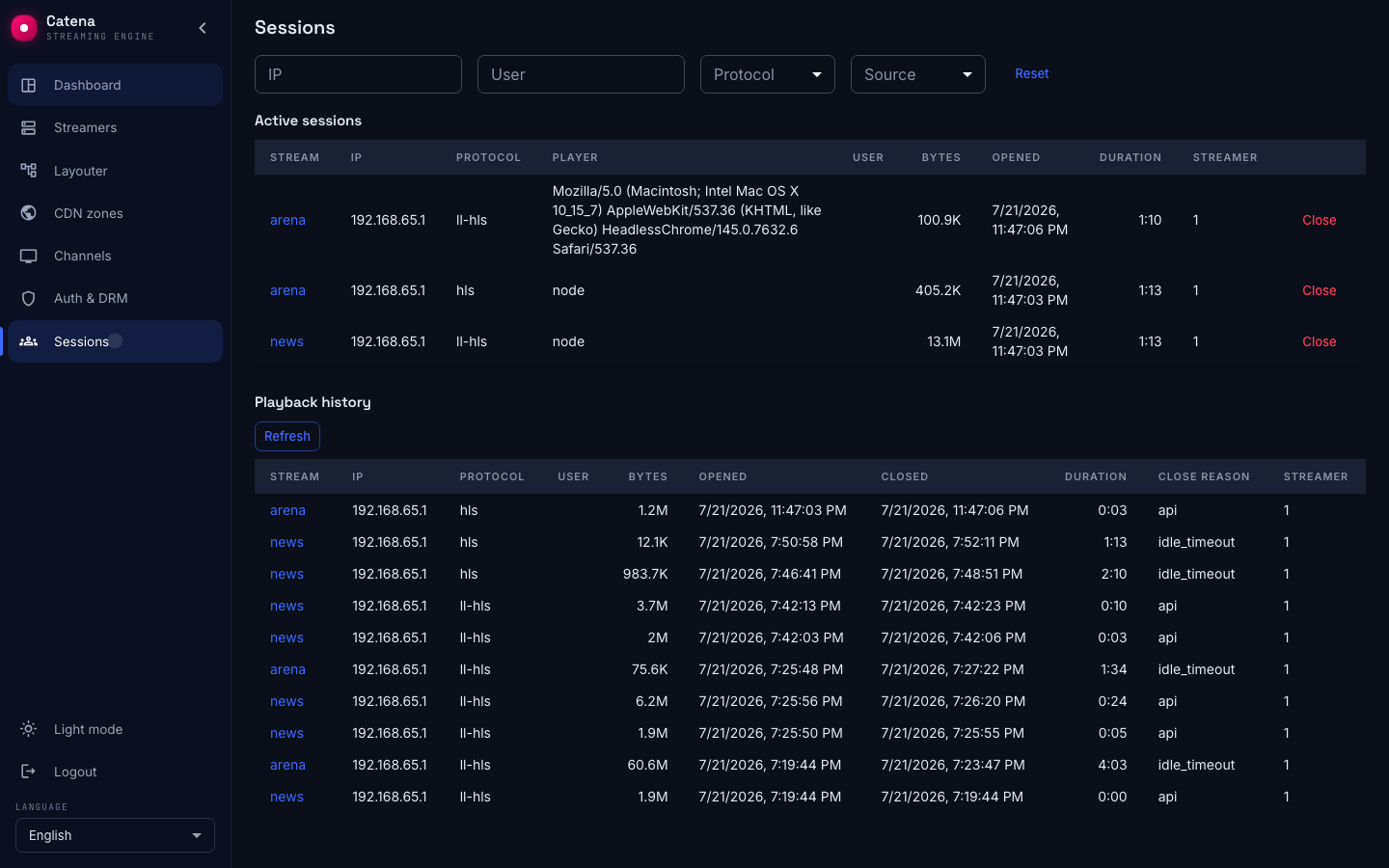
A session is one viewer playing one stream. The moment a viewer is authorized and starts pulling, a session opens on the streamer; when they stop, it closes and moves to the history. The Sessions screen shows both halves of that life — who is playing now, and who played recently. The same table lives on the Sessions tab of a stream's page, filtered to that one stream.
Every session is here whichever way its viewer was authorized — a Catena ticket, your own backend, or a shared token. Authorization decides whether a viewer gets in; the session is what exists while they watch.
Open sessions
An open session is a viewer playing right now. The table refreshes every couple of seconds:
| Column | What it shows |
|---|---|
| Stream | Which stream the session plays; for a VOD session — the asset key with a link to its card |
| IP | The viewer's address |
| Protocol | What it pulls with: hls, dash, mpegts…; the DVR badge — the session watches the archive, not the live air |
| Player | The client's user agent |
| User | The user id, if the player passed one; the shared chip — different clients play under one user at the same time |
| Bytes | Served to the session; the counter updates at the streamer's checkpoint cadence — seconds on a small installation, tens of seconds under load |
| Opened, Duration | When it started and how long it lasts |
| Streamer | Which streamer serves the viewer |
The filters above the table — IP, User, Protocol, Source (Live and DVR / Live / DVR) — apply to both the open table and the history; Reset clears them all.
Close a session by hand
The Close button in a row tears the session down on the streamer — with a confirmation: the player will have to open a new one. It is a diagnostics and cleanup tool, not a ban: a live player usually reconnects within seconds. Keeping a viewer out is a job for playback authorization, not for this screen.
When a session closes
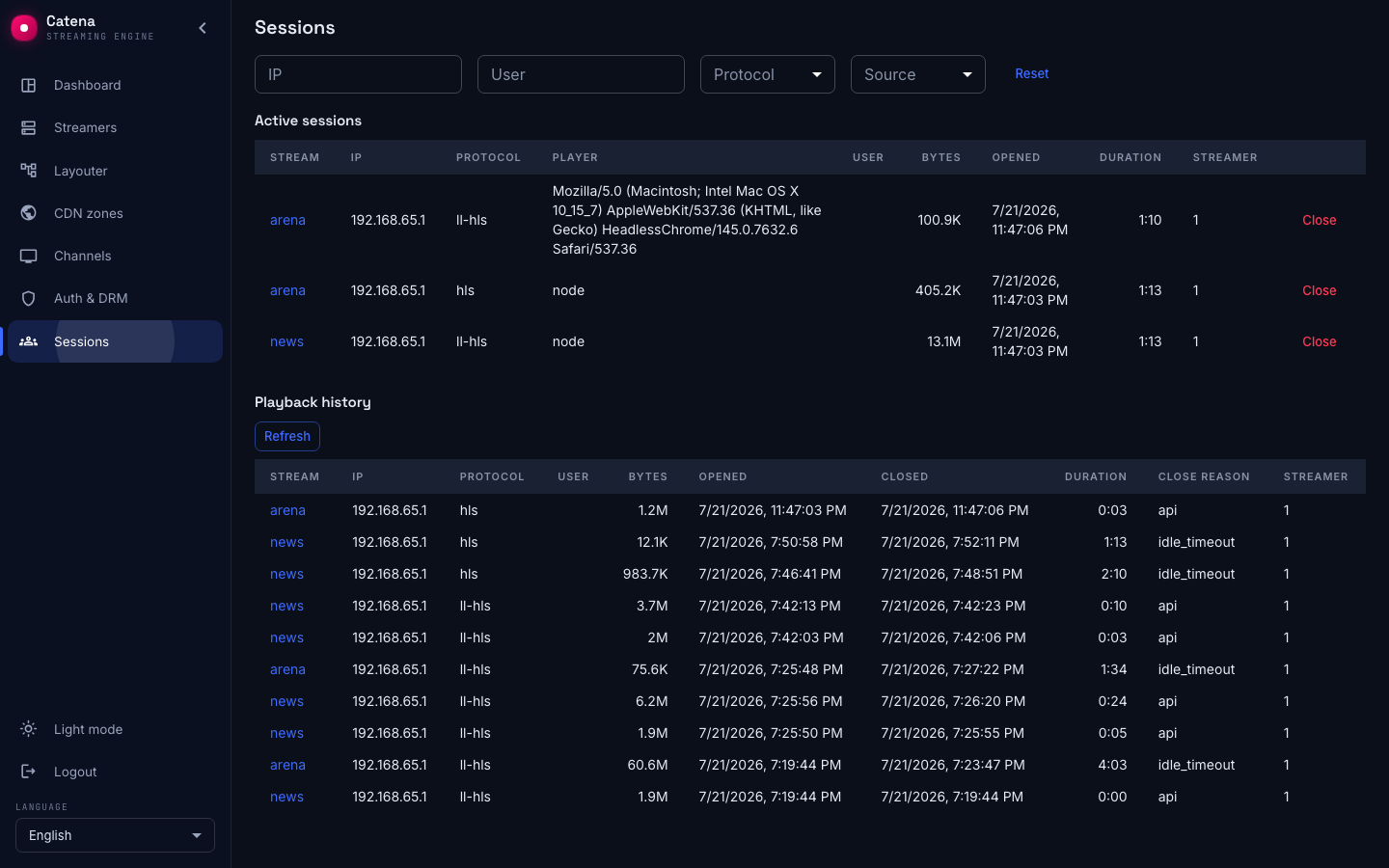
A session leaves the open table and lands in the Playback history — sessions closed over the last day, with Closed and Close reason added to the columns — for any of these reasons:
- The viewer stopped. The player closed, or simply went quiet: after a short idle timeout with no more segments pulled, the streamer closes the session on its own.
- You closed it from the screen above.
- The ticket was revoked, or hit its screen limit — the streamer drops the viewer within seconds (see Catena tickets).
- The ticket expired — a ticket carries a hard end time, and a session cannot outlive it.
The history does not refresh on its own — re-read it with the Refresh button.
A cluster hiccup does not interrupt a viewer
Admission happens on the streamer, not in the middle of playback. With a Catena ticket the streamer checks the ticket itself — signature, expiry, scope, and its local revocation list — with no call over the network to admit a viewer. So if a streamer briefly loses contact with the rest of the cluster:
- Viewers already watching keep watching. Their sessions live on the streamer that serves them; nothing central is on the playback path.
- New viewers still get in. A valid ticket is admitted offline, with no round-trip to anyone.
- Revocations catch up on reconnect. The streamer rebuilds its revocation list from the cluster the moment contact returns, before it admits the next viewer, so a ticket cancelled during the gap is refused as soon as the link is back.
The one thing that does go dark is reporting, not playback — see below.
When sessions are missing from the screen
If central cannot reach some streamer's management API, a banner appears above the tables: those streamers' sessions are absent from the output — from the open list and from fresh history alike. The streams keep working and the viewers keep watching: it is the reporting that goes dark, not the delivery.
The fix lives in the streamer's reachability: in the registry such a machine carries a reachability chip, and it leads to the cause.