Stream details
The stream page answers the question “what is riding in the stream right now”: next to the settings stands a track summary — one row per track. Without a transcoder there is a single block, Media info. When the transcoder runs, there are two: Input, before the transcoder and Output, after the transcoder.
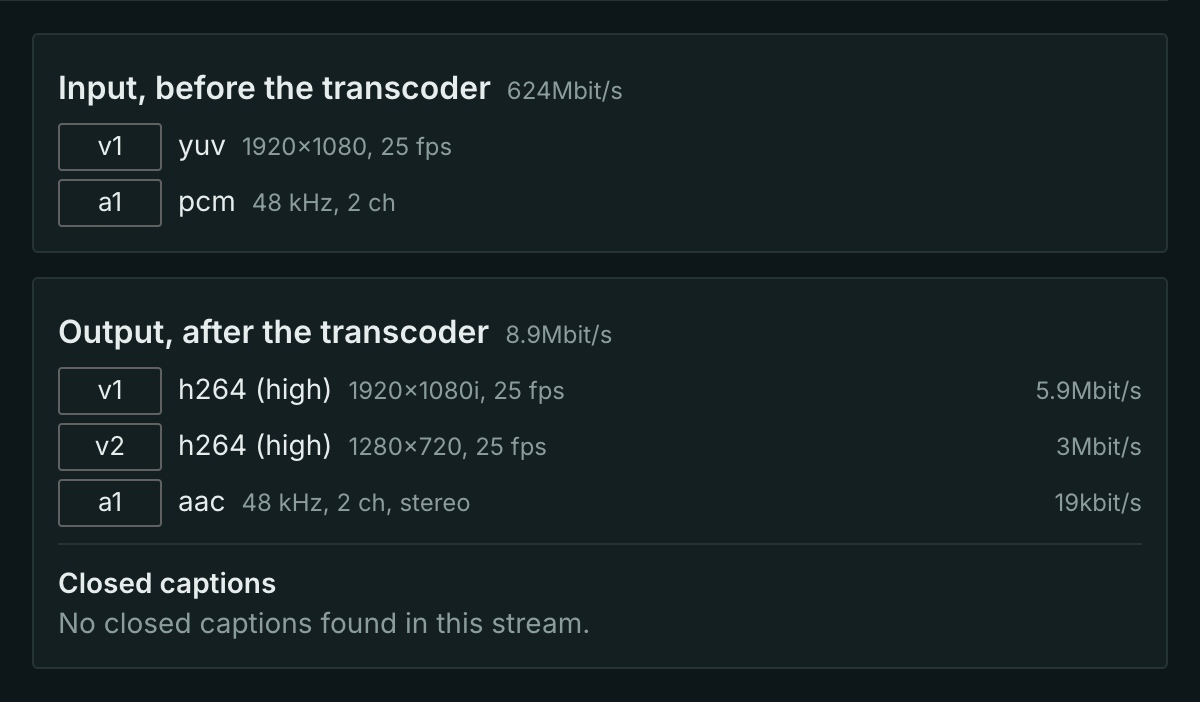
Video track
The video track row reads left to right:
- address
v1— the track number: pushes and transcoder rungs select tracks by it; - codec and profile —
h264 (high): the profile appears in parentheses once it is parsed from the stream; names are lowercase —baseline,main,high,main10and others; - size and scan —
1920x1080: the display geometry of the frame; the letteriafter the size (1920x1080i) means interlaced scan, progressive and unknown go without the letter; - pixel shape —
SAR 16:11on an anamorphic track, next to the size: the pixels are not square, and the display geometry is wider than the raster (see Anamorphic video and SAR); - frame rate —
25 fps; - bitrate — on the right of the row, the measured track rate.
Audio track
- address
a1and codec —aac,ac3; - sample rate —
48 kHz; - channel count —
2 ch; - layout —
stereo,5.1(side),7.1: canonical channel-set names, as ffprobe prints them.
The layout appears only where the source states it exactly: AC-3 and E-AC-3 carry a channel mask, transcoder output tracks carry the encoder's actual layout. A codec that signals a bare channel count does not invent a layout: the track aac, 48 kHz, 2 ch has no layout, and that is neither mono nor an error.
Text tracks
Subtitles, teletext and recognized speech stand in the output summary next to video and audio: teletext as a tree of its pages, closed captions as a section of their own with their services. Details are on the Subtitles and teletext and Speech recognition pages.
Input and output
The two summaries side by side answer the question “what did the transcoder do”: the input describes the source, the output — what reaches the viewer. The row differences read directly:
- a profile on the output against a raw codec on the input — the input was transcoded;
1920x1080ion the input against1920x1080on the output — the interlaced scan was resolved;6 chon the input against2 chon the output — multichannel audio was downmixed to stereo.
In the API
The same composition is served by GET /streamer/api-v4/streams/stats/{name}: media_info is the output, inputs[].media_info is the input.
{
  "media_info": {
    "tracks": [
      { "id": "v1", "content": "video", "codec": "h264", "profile": "high",
        "width": 1920, "height": 1080, "interlaced": true, "field_order": "tff",
        "fps": "25", "bitrate_kbit": 5900 },
      { "id": "a1", "content": "audio", "codec": "ac3", "sample_rate": 48000,
        "channels": 6, "channel_layout": "5.1(side)", "bitrate_kbit": 384 }
    ]
  }
}
An anamorphic track carries sar_width/sar_height and the raster pixel_width/pixel_height. The fields are optional: a missing field means “the source did not report it”, not zero and not a default.