Templates
Broadcasts in a company are of a kind. Departmental meetings are configured alike, training broadcasts alike, round-the-clock internal channels alike. A template is a set of settings written once and inherited by every broadcast that refers to it.
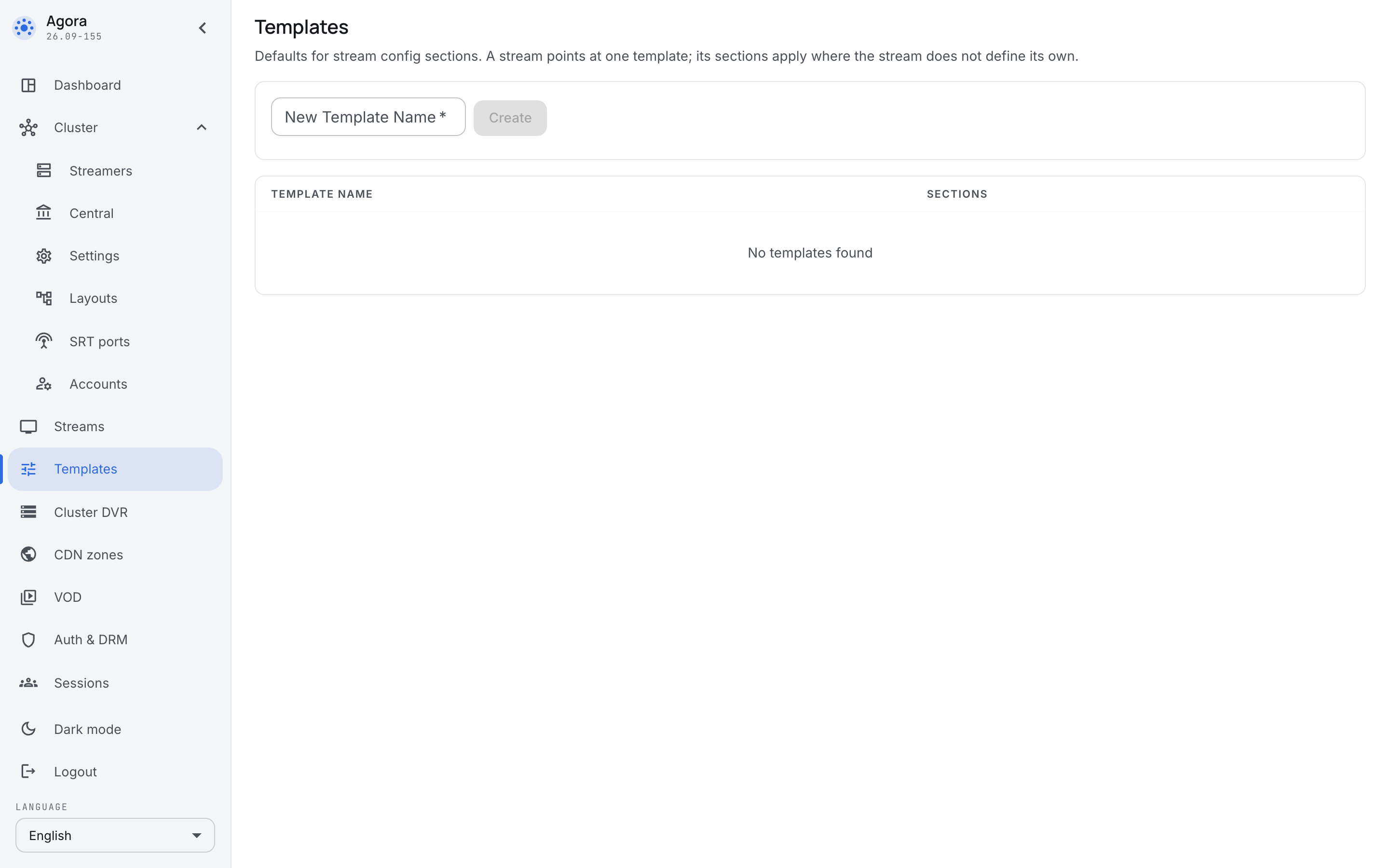
What they are for
Without templates, a dozen broadcasts of one kind are a dozen places where the same setting has to be entered and later remembered when it changes. The mistake that follows is a quiet one: the broadcast works, it is merely not the same as its neighbour, and that is discovered during a meeting.
With a template the setting lives in one place. Change the archive depth in the template and it changes for every broadcast that inherits from it.
What goes into a template
A template carries what a group of broadcasts has in common:
- the transcoder ladder — which links the picture is prepared for;
- the archive depth — how many weeks recordings are kept;
- intake rules — source timeouts, behaviour when the signal is lost;
- playback protection — who may open the broadcast and under what rules.
The name, the source and everything a broadcast owns are not put in a template: a template describes a kind of broadcast, not the broadcast itself.
How a broadcast is bound to a template
The template is chosen on the broadcast's card, in the Template field, and is shown in the list's column. A setting entered on the broadcast itself wins over the template's — that is how an exception is made for one broadcast without breaking the rest.
A broadcast's start mode defaults to As in the template: that is inheritance by default — the broadcast behaves the way its kind is meant to.
The working order
There is no point in a template per broadcast; it saves nothing then. A template appears once there is more than one broadcast of a kind and a setting starts repeating:
- Configure the first broadcast the way it should be.
- Create a template with the same settings and name it after the kind —
all-hands,webinar,training. - Move the other broadcasts of that kind onto it.
From then on the setting changes in the template, not in every broadcast in turn.