From "never break" hardware to a self-healing 800-channel headend
A US content aggregator replaced 50 legacy hardware encoders with Mcaster to ingest and retransmit ~800 channels — automatic failover for failing gear, full visibility across input and output, and 60% fewer customer complaints.
Our Client
Company
A B2B content aggregator in the United States
Industry
B2B media / content aggregation
Challenge
The aggregator takes around 800 channels from providers and retransmits them onward to its own B2B customers. Its headend ran on legacy hardware encoders built on a "never break" promise — expensive, single-purpose iron that, when it did fail, caused outages with no automatic recovery. Worse, the team could only see the input side: ingest was monitored, but delivery to customers (pushes and play sessions) was not, so complaints arrived from the outside with no internal picture of why.
Key Results
- •Customer complaints down 60%
- •50 legacy hardware encoders replaced
- •Automatic failover for failing equipment — no more manual recovery
- •Full visibility across input and output, including pushes and play sessions
- •Migrated in 3 months
About the Project
Client's Goal
Keep ingesting and retransmitting ~800 channels reliably, stop depending on hardware that had to "never break," and finally understand why customers complained — before the complaints came in.
Our Solution
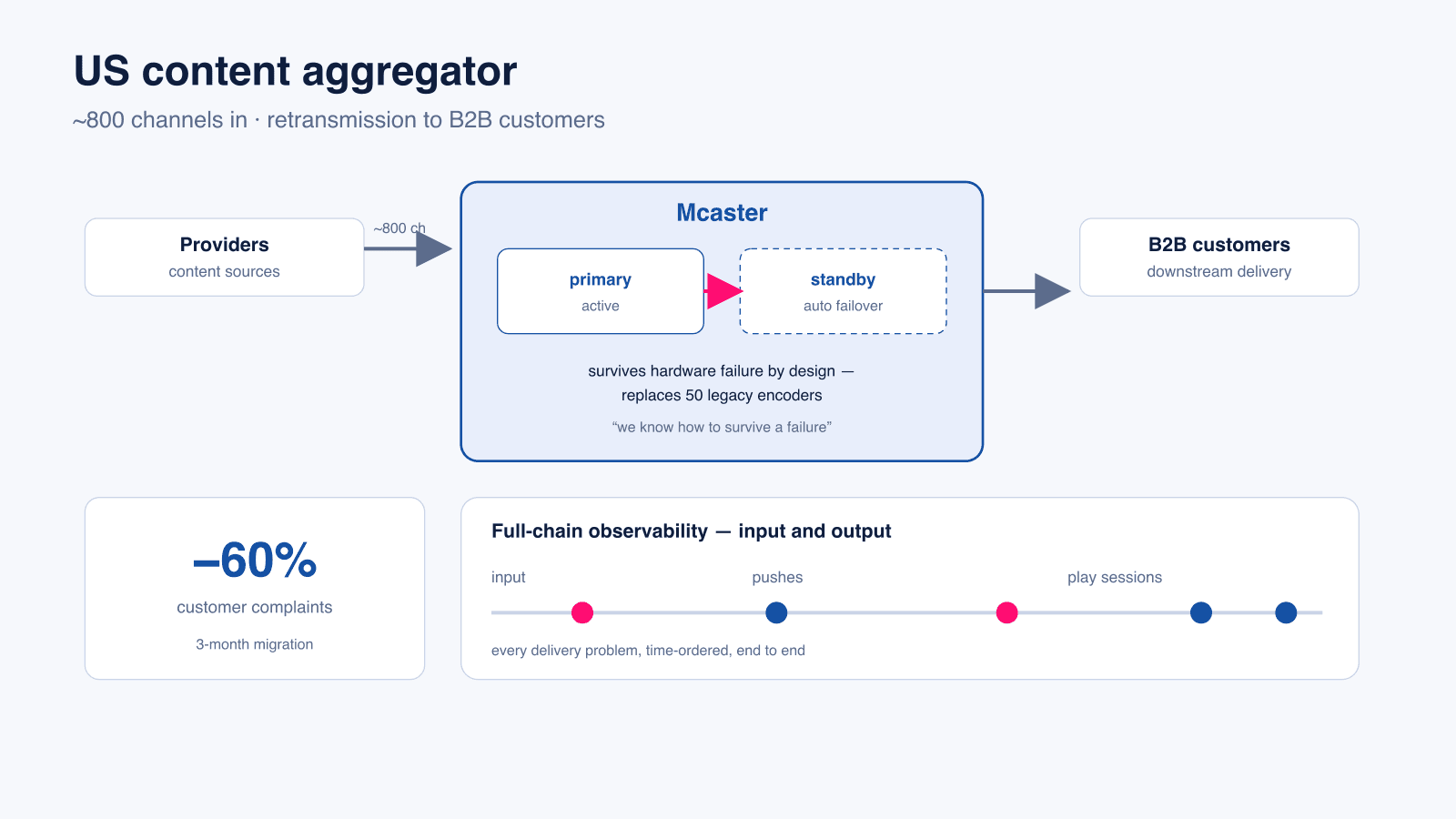
The aggregator replaced its 50 legacy encoders with Mcaster, Flussonic's TV signal contribution platform. The design philosophy shifted from "hardware that never fails" to "we know how to survive a failure": Mcaster automatically reserves and fails over around breaking equipment, so reliability comes from redundancy rather than heroic iron. Mcaster also watches the whole chain — not just ingest, but pushes and play sessions — so the operator gets a complete, time-ordered picture of every delivery problem reaching customers. The migration took three months.
Results
Key Achievements
- •Customer complaints dropped by 60% — problems are now seen and fixed before customers notice
- •50 legacy hardware encoders retired in favor of a self-healing, redundancy-based setup
- •Automatic failover around failing equipment removed manual recovery from the runbook
- •A single time-ordered view of input + output (pushes, play sessions) replaced guesswork about where delivery broke
- •~800 channels continue to flow to the aggregator's B2B customers uninterrupted
"We finally saw why our customers complain — and how to fix it." — Operations lead, US content aggregator
Want a similar setup?
Tell us about your project — we'll size the architecture and send you an estimate.
Learn more about Mcaster