Home and business video surveillance: how privacy shapes what people buy
A camera in a bedroom and a camera over a loading dock are the same piece of hardware, but they are not the same product. What separates them is privacy: who ends up in the frame, what they were promised, and what happens to the recording afterwards.
That difference decides where the video is stored, who can open it, how long it is kept and whether the system is allowed to know a person's name. If you sell, deploy or operate surveillance, it is worth mapping the market along three axes: the type of customer, the location of the camera, and the job the camera was hired to do.
Two buyers who mean different things by "security"
| What differs | Private customers (B2C) | Business customers (B2B) |
|---|---|---|
| Main priority | Personal safety, keeping an eye on family, peace of mind | Business continuity, protection of assets, process efficiency |
| Sensitivity to privacy | High. A camera inside the home reads as an intrusion into private life | Moderate. Bounded by labour law and data protection rules rather than by feelings |
| Where video lives | Cloud services from a recognisable brand, chosen for convenience | On-premise servers (NVR/NAS) or a private hybrid cloud, chosen for control |
| Legal exposure | Filming guests, nannies or tenants without their knowledge | Fines for recording employees or customers without notice |
The practical consequence: a home user will trade control for convenience and a business will do the reverse. A homeowner accepts that footage sits on someone else's server because the alternative is configuring storage. A retail chain will not, because a leaked recording is a regulator's letter, not an embarrassment.
The privacy gradient runs from the bedroom to the street
Anxiety about being filmed is not evenly spread across a building. It is highest in a bedroom, lower in an open-plan office, lower still in a lobby, and close to zero on a fence line facing a public street. Every design decision that touches privacy should follow that gradient rather than apply one policy to every camera in the account.
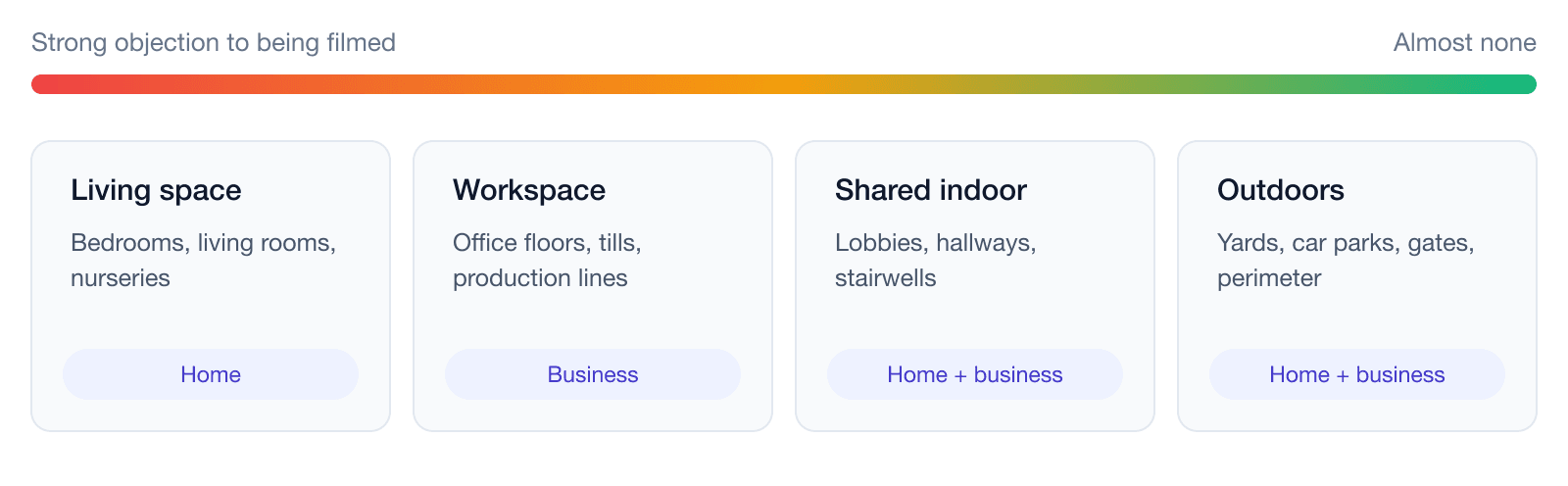
Indoors is the sensitive end. At home, the fear is not the burglar but the breach: intimate footage leaving the house through a compromised account. This is why mechanical shutters sell, and why people physically unplug cameras when they come home — a behaviour that tells you the software failed to offer a credible way of turning recording off. In an office or a warehouse, the same camera reads to employees as total supervision, while for the employer the privacy question quietly shifts to protecting trade secrets from the staff themselves.
Outdoors is the calm end. Doorbell cameras, balconies, entrance halls, yards, car parks, perimeter fences — the space is already public, so objections are rare. Where a conflict does appear in the home segment, it is usually with the neighbours whose front door falls inside the frame, not with an intruder. In business, perimeter surveillance is the least contested part of the system: the area is open to the public and the security rationale is obvious.
What the camera is actually hired to do
The job determines which privacy trade-offs a customer is willing to make.
In the home:
- Watching household staff — nannies, cleaners, contractors. The camera goes inside, and the customer knowingly trades away some privacy, their own included, to protect children or belongings.
- Checking on children and pets — indoor cameras with two-way audio. Instant access beats privacy here, because the person watching is the person being reassured.
- Deterring break-ins — outdoor cameras at doors and windows, or indoor cameras that only record in "armed" mode when nobody is home. This is the best balance available in the segment, and the scenario customers describe most readily.
In business:
- Retail loss prevention — cameras over tills and stockrooms, pointed at workstations. Employee privacy is thin here because the financial exposure is an order of magnitude larger.
- Customer behaviour analytics — heatmaps, footfall, queue length in the sales floor. Modern systems depersonalise by design: count silhouettes, estimate gender and age bracket, and never attach a name.
- Workplace safety and discipline — hard hats, masks, restricted zones on a production site. Privacy objections carry little weight against occupational safety obligations, and the recording is often mandated rather than merely permitted.
Face and licence plate recognition sit apart from the rest of this list. They turn footage into identity, which is exactly the step that regulators scrutinise, so they belong on the cameras where identification is the point — an access control gate, a checkpoint — and nowhere else.
How much of a subscriber base will actually buy this
A provider's commercial director is not asking whether surveillance is a good product. The question is how many subscribers will pay for it. The axes above answer exactly that, because they cut one subscriber base into pools that convert at very different rates and have to be counted separately.
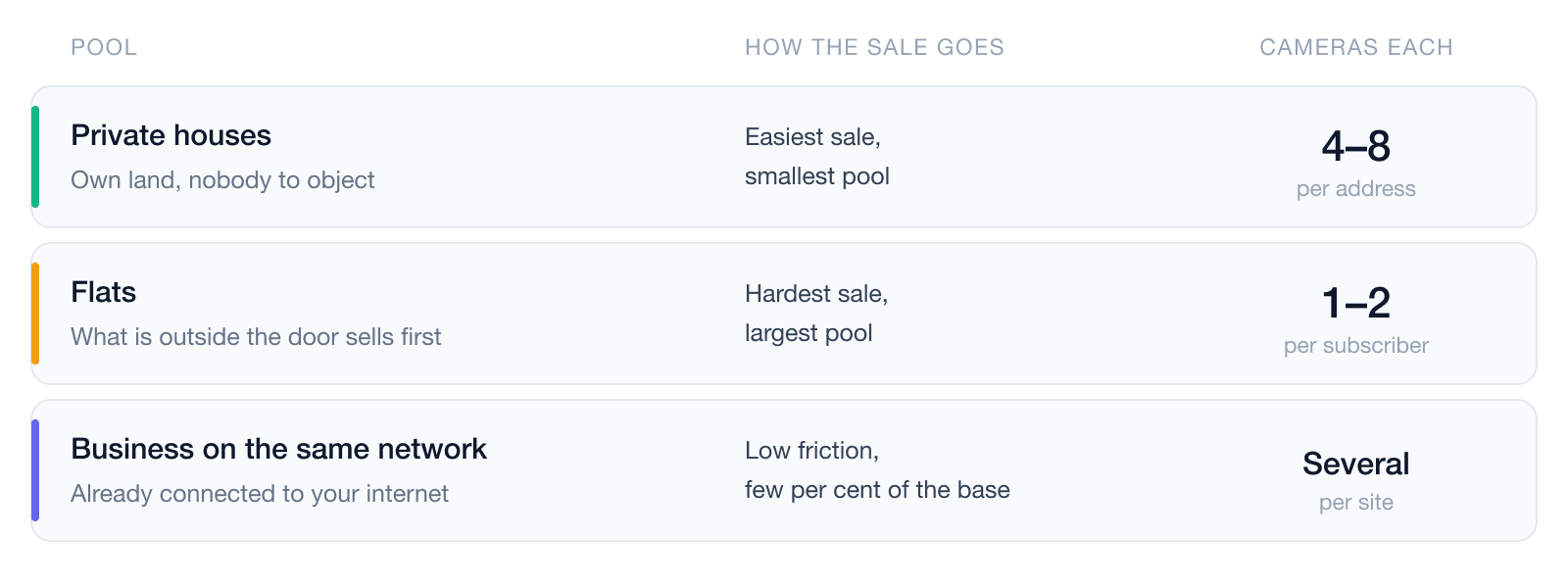
- Private houses — the densest demand in the smallest pool. Own land, own fence, and nobody for a privacy objection to come from. An address here is not closed by one camera but by four to eight: gate, yard, entrance, outbuilding. In an urban provider's base this pool is a minority, but the first sales come from it and the ticket is several times the base average.
- Flats — the largest pool and the hardest conversion. The objection is the one this article opens with: a camera inside the home reads as an intrusion. What sells first is everything outside the door — entrance, hallway, yard, parking — and that is one or two cameras per subscriber. The indoor camera, and the more expensive plan that comes with it, is an upsell earned once the subscriber is already used to their video being kept by you.
- Small business on the same network — a few per cent of subscribers, a disproportionate share of revenue. Shops, cafés, salons and workshops are already connected to your internet. More cameras per site, deeper archives, lower churn, and almost no privacy objection, because the law expects the till area to be watched anyway. Some of them will want the archive to stay on site — an on-premise NVR managed from the same account as the residential cameras.
- Cameras per subscriber matter more than the penetration rate. Revenue is subscribers who bought, multiplied by cameras each, multiplied by the plan. Houses and small businesses bring several cameras per contract, flats bring one or two — so effort spent on the first two pools pays back faster than the same conversion gain in the third.
- Privacy drives conversion, not satisfaction. A subscriber who says no to an indoor camera is not an unhappy customer, they are a sale that never happened. Two things remove the objection: the video stays with their own provider in their own country rather than travelling to a global cloud, and "how long do you keep it" has a straight answer. In Watcher that answer is the billing plan — archive depth, event storage and the analytics set are applied to cameras through presets. And for that trust to work in your favour the service has to look like yours, which is what interface and mobile app branding is for.
- Only a pilot gives you the real share. Run it in one district or one city and measure conversion per pool: a single average across the whole base blends detached houses with tower blocks and is useless both as a forecast and as a budget defence. The pilot also gives you the second number that matters — how many subscribers are still there after six months. A service built on an accumulated archive holds people, because leaving means losing the recordings, not just changing a plan.
What this means for the platform behind the camera
Serving pools this different from one installation puts a short list of demands on the software.
- Video has to be able to live in more than one place. A subscriber service needs cloud recording; a shop or a factory needs an archive that never leaves the site. Watcher records to a central server or to an NVR next to the cameras, and the analytics can run there too — the video is processed at the edge and only the event travels.
- "Who can see what" has to be granular. Privacy in a multi-tenant system is an access model, not a promise. Watcher separates subscribers into organizations and assigns per-user permissions down to individual cameras and folders, so an installer, a security guard and a shop manager see three different systems.
- Analytics should look only where it needs to. A camera covering a yard and a pavement does not have to analyse both. Detection zones restrict analytics to the part of the frame that matters, which narrows the data collected as a side effect of narrowing the false alarms.
- Someone will ask who watched. Being able to show who opened which archive and when is what turns a surveillance system from a liability into evidence — for a business customer, and for you the moment a subscriber asks. Watcher logs user actions for exactly that reason.
The segmentation, in the end, is not about camera specifications. A bullet camera on a warehouse wall and a desk camera in a nursery may have identical sensors and identical bitrates. What differs is the answer to one question — who is in the frame, and what were they told — and a platform that cannot express that answer will eventually be asked to.
Flussonic Watcher is built for both ends of that spectrum: subscriber video surveillance for internet providers and full on-premise deployments for enterprise and municipal sites. See the Watcher product page or request a trial to try it on your own cameras.